
Churches in the Midst of Polarisation
Date
August 21, 2026 - August 25, 2026Call for papers closed:February 28, 2026Registration closed:Venue
Where:Utrecht (Netherlands)Adress:Protestant Theological University, Jansdam 14, 3512 HB UtrechtChurches in the Midst of Polarisation
This ecumenical Academic Consultation will critically examine phenomena of polarisation in church and wider society and explore initiatives toward depolarisation. In recent times, political discourse has become increasingly divisive, resulting in palpable tensions and hostility within society. The consultation will address the role of churches and ecumenical organisations in the context of polarising dynamics. It will explore the approaches adopted by these institutions and the manner in which they utilise their positionality. Different types of polarisations, their motives, narratives, dynamics and impact will be examined. This will entail addressing the harm and injustice experienced, and analysing theological responses, and the potential for transformation.
About Consultation
The consultation will discuss the ways in which churches function as colonising or decolonising spaces, and the manner in which theological discourse on gender and identities has been framed in antagonistic terms. The consultation will address the role of symbols and rituals in processes of polarisation and reconciliation. It will also focus on the complex question of truth-seeking amidst conflict and hostility, as a core theological task in the church, as well as in academic and ecumenical spheres. Speakers and participants from a variety of backgrounds and church traditions across Europe will engage in joint analysis and constructive theological reflection.
The following sub-themes will be addressed:
(1) Types of polarisations in churches and in society;
(2) Church as a de/colonising space;
(3) Advocacy or diplomacy: The role of the churches in polarising contexts;
(4) Gender as a de/polarising topic;
(5) Symbol and ritual mediation in reconciling polarisations;
(6) Truth finding in the context of de/polarisation.
Information about the venue, accommodation, and public transport can be found below in section “Venue”.
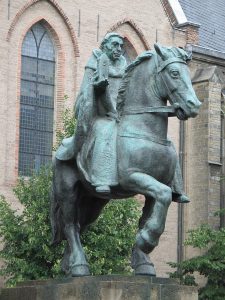
Statue of Saint Willibrord (†739), “apostle of the Frisians”, on Janskerkhof square in Utrecht.
LIST OF SPONSORS
The consultation is held with the support of the following sponsors:
Council of Churches in the Netherlands, Marienburgvereniging, Oud-Katholiek Seminarie, Old Catholic Church of the Netherlands, Protestant Theological University Utrecht, Stichting Oud-Rustenburg, Tilburg School of Catholic Theology Utrecht, Unie van Baptistengemeenten, Utrecht Theological University, Vrijzinnige Fondsen.
CALL FOR PAPERS
Junior and senior scholars are invited to submit proposals for short papers (15 minutes) which preferably address the theme of the conference and its sub-themes. Proposals on other theological and ecumenical topics may also be submitted. There will be also a slot for poster presentations. All proposals will be evaluated by the standing committee. The working language of the conference is English.
The call for papers was closed on February 28, 2026. The decision of acceptance will be communicated before the end of March 2026. After the conference, presenters will be invited to submit their papers to be considered for publication in the conference proceedings.
Call for papers
Confirmed speakers
Programme
August 21, 2026
Friday
To be determined.
August 22, 2026
Saturday
To be determined.
August 23, 2026
Sunday
To be determined.
August 24, 2026
Monday
To be determined.
August 25, 2026
Tuesday
To be determined.
Venue:
The primary conference location will be the Protestant Theological University in Utrecht, Jansdam 14, 3512 HB Utrecht. For a map, see here
Accomodation:
Participants will be responsible for booking their own accommodation in Utrecht. Early booking is recommended.
Regular options in the city are:
- Van der Valk Hotel de Bilt, https://booking-v5.vandervalkonline.com/hotel-de-bilt-utrecht/configuration?promotionCode=BIL-SOC-OEC
- Van der Valk Hotel Utrecht, https://www.vandervalkhotelutrecht.com/
- NH Hotel Utrecht, https://www.nh-hotels.com/en
- Holiday Inn Utrecht, https://1url.cz/@ihgcom
- Hello Stay Utrecht, https://hello-stay.nl/
- Bastion Hotel Utrecht, https://www.bastionhotels.com/en-gb/hotels/hotel-utrecht
Arrangements with these hotels are being finalized and updates will be made available here.
Budget (and very basic) options are:
- Bunk Utrecht; https://wearebunk.com/utrecht – discount code: UTRUNI
- Stay OK Utrecht Centrum; https://www.stayokay.com/en/hostel/utrecht-centrum – discount code: UU
AirBnB options can be explored individually.
Public transport:
Public transport in the Netherlands and Utrecht is generally well-organized. Trains, buses, trams and metro’s can be used by either obtaining an ‘OV chipcard’ or simply by means of one’s debit or credit card. There is a convenient explanation on https://www.ns.nl/en/travel-information/check-in-check-out/debit-card (what is said there about trains also applies to other forms of public transport). Planning trips can be done through https://9292.nl/en/www.ns.nl (trains, but also other forms of public transport) or of course other navigation tools.
CODE OF CONDUCT
for Participants in the 23rd Academic Consultation of
SOCIETAS OECUMENICA
THE EUROPEAN SOCIETY FOR ECUMENICAL RESEARCH
in Utrecht, August 21-25, 2026
[Approved by the Membership Assembly, as of 2024-09-09]This document is intended for participants of the Academic Consultation organized by Societas Oecumenica to facilitate compliance with the Societas Oecumenica’s Code of Conduct, and to provide a procedure for handling possible infringements.
At the meeting there will be two appropriately equipped persons (male and female) on site who are appointed as a “Response Team” by the Standing Committee (not being members of it). You may contact them either by sending them e-mail to: societas.codeofconduct@gmail.com, or directly.Preamble
Each human being has dignity and therefore needs to be respected and protected. This fundamental insight needs to be expressed coherently in the ways we meet and interact in events that bring us together. Basic ethical commitments and standards are to be lived out in the work of the Societas Oecumenica. These include:
- Respect for the dignity and integrity of all human beings.
- Fair and just treatment of all, without discrimination, exploitation, or harassment.
- Responsible stewardship in the exercise of power and use of financial and other resources.
- Respect for diversity, inclusiveness and participation, and transparency and accountability.
All participants are expected to comply with these commitments.
These commitments to human dignity call for special attention in international and multicultural work contexts where differences based on for instance ethnicity, religion, gender, sexual orientation, age, or disability can lead to attitudes or practices that violate individuals’ personal integrity or sense of what is appropriate.
The temptations to misuse power, harass and exploit others, also in relation to sexuality, are considerable, and therefore must be constrained. The Societas Oecumenica’s Code of Conduct embodies zero tolerance with regards to sexual exploitation and abuse, harassment, abuse of power, fraud and corruption in all events and applies rules for any breaches or violations. No one should be subjected to any misconduct from any participant. Therefore, all participants are called upon to:
- Treat all persons fairly and with respect, courtesy, and dignity.
- Behave respectfully towards others and do not misuse private, professional or any other relationships.
- Be aware of the special responsibility that any person in authority has.
- Be mindful of relationships of dependence.
- Be sensitive to cultural and social differences and practices.
Commitment
As a participant in the Societas Oecumenica’s Academic Consultation, I commit to:
- Do not cross boundaries set by others. If someone indicates “No”, even without words, respect it. Avoid any inappropriate gesture or contact.
- Respect and promote fundamental rights of each person, without discrimination.
- Avoid any behavior that is considered an offense under Criminal law or maybe legally understood as abuse, exploitation, misconduct, or sexual harassment.
- Declare conflicts of interest and follow ethical and legally acceptable organizational and business practices.
- Avoid using or encouraging others to use alcohol or other substances in a way that affects their ability to carry out their role.
- Do not exchange money, goods, or services for any kind of sexual favors.
- Never commit any act of fraud, corruption, or unethical business practice, including conflict of interest during Societas Oecumenica events.
- Do not falsely accuse people of harassment or exploitation of any kind for your own advantage.
In all cases International human rights law and the law of the country where the Academic Consultation of the Societas Oecumenica takes place apply.
Procedure
The Standing Committee will have introduced the Response Team on the Code of Conduct and the procedures to follow before the meeting.
At the beginning of the meeting (first session), the organizers will remind all participants about the Code of Conduct. The Response Team should be introduced.
Should anyone need to make a complaint, the following procedures shall apply:
- Approach a member of the Response Team at this event or fill out the Complaint Form available at the Conference’s website or at the Infopoint.
- Hand the filled-out complaint form to any member of the Response Team or send it to societas.codeofconduct@gmail.com.
- Complaints can be handed in until six months after the conference.
All complaints should be carefully and promptly investigated, meeting privately with the subject of complaint and the complainant (person making the complaint).
For the complainant and subject of complaint, counseling, pastoral care, and accompaniments made available.
The Response Team reports to the Standing Committee of the Societas Oecumenica which makes the decision about the necessary actions.
The Standing Committee may, in its sole discretion, find it necessary to remove the subject of the complaint from the meeting or bar the person from situations where the offence could be repeated. The subject of the complaint shall be informed of the decision.
In cases where the complainant wishes to consider reporting the incident to the relevant legal and/or ecclesial authorities, he or she shall be offered pastoral support in considering such report. However, if the person decides to pursue legal action against the subject of complaint, Societas Oecumenica, as an organization, can in no case be held liable, directly or indirectly, for such act and its possible prejudicial consequences.